
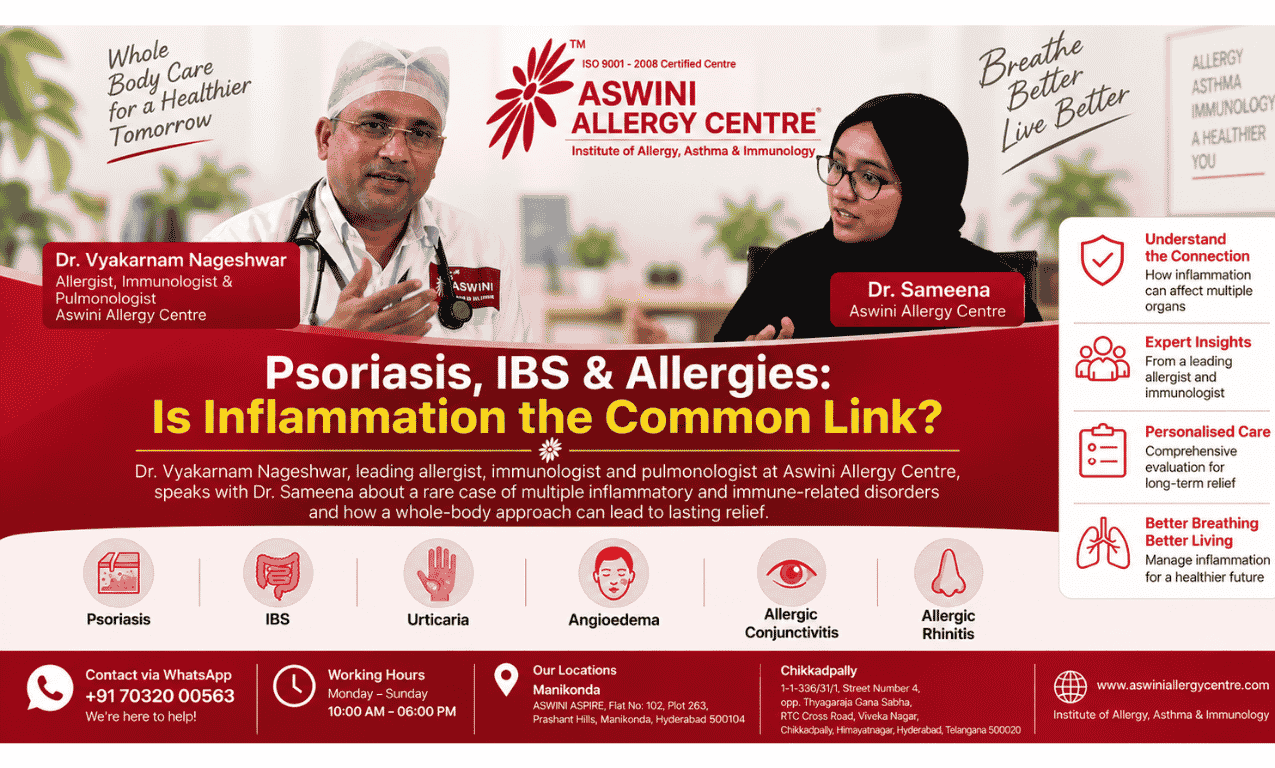
A 21-year-old man with psoriasis, irritable bowel syndrome (IBS), urticaria, angioedema, allergic conjunctivitis and allergic rhinitis had spent years consulting different specialists as his symptoms appeared one after another.
For nearly 5–10 years, the problems were treated separately, with consultations involving dermatology, gastroenterology, ENT and other specialties. Psoriasis was managed with topical treatments and, when symptoms became severe, steroid medication. IBS was treated symptomatically, while later episodes of photosensitivity, eye watering, allergic rhinitis, lip swelling, rashes and itching added further concerns.
Seeking a deeper understanding of why so many apparently different problems were occurring in the same young patient, he eventually reached Aswini Allergy Centre, Hyderabad, accompanied by Dr. Sumaina, a qualified general physician from Karnataka.
According to Dr. Vyakarnam Nageshwar, Pulmonologist, Allergist and Immunologist at Aswini Allergy Centre, the case highlights an important principle in understanding inflammatory and immune-related disorders: the human body cannot be viewed as a collection of completely independent organs when multiple immune-mediated symptoms occur together.
Check the full video here.
When Different Symptoms May Have a Common Connection
The patient had a history of seborrheic psoriasis and had been receiving treatment for the condition. He also developed IBS, followed by episodes of lip swelling, rashes, itching and constipation.
His symptoms had not all appeared at the same time. Psoriasis had been present for several years, while IBS and allergic symptoms developed at different stages. More recently, he had also experienced photosensitivity, allergic watering of the eyes and allergic rhinitis.
The changing pattern raised an important question: were these simply several unrelated conditions occurring in the same person, or could there be a deeper inflammatory and immunological connection?
Dr. Nageshwar said the detailed history suggested that the different manifestations needed to be considered together rather than viewed as isolated problems.
In this case, the medical history included psoriasis, IBS, urticaria, angioedema, allergic conjunctivitis and allergic rhinitis. The symptoms involved different parts of the body, but the underlying inflammatory and immune mechanisms needed to be examined as a whole.
A Young Patient With Multiple Diagnoses
Dr. Sumaina, who accompanied the patient, said the number of problems developing in a person barely in his early twenties prompted her to look beyond individual diagnoses.
In routine clinical practice, patients with skin symptoms may be directed to a dermatologist, gastrointestinal complaints to a gastroenterologist, nasal symptoms to an ENT specialist and other concerns to their respective specialties.
In this case, however, the question was whether repeatedly treating each symptom separately was addressing the reason why multiple problems were developing over time.
The patient’s journey had involved what Dr. Sumaina described as multiple consultations and symptomatic treatments. Psoriasis had been treated with steroid creams and antifungal shampoos, while more severe episodes had required steroid tablets. When IBS developed, symptomatic treatment was again provided.
Later, allergic rhinitis, conjunctival watering and photosensitivity appeared, adding another layer to the clinical picture.
This progression led to the need for a more comprehensive evaluation.
Looking Beyond Individual Organs
The case prompted a broader discussion between Dr. Nageshwar and Dr. Sumaina about the role of immunology in connecting apparently separate clinical manifestations.
Modern medicine has developed highly specialised fields for different organs and systems. While this specialisation allows doctors to develop expertise in specific areas, complex inflammatory and immune-related conditions can sometimes require a broader perspective.
Dr. Nageshwar explained that the different manifestations could be viewed as branches and leaves arising from a common trunk of inflammatory and immune mechanisms.
The central learning point, he said, is to consider the patient as one human body and understand how the immune system may connect symptoms affecting different organs.
Immunology Can Help Connect the Dots
Following detailed clinical discussions and investigations, the focus shifted towards understanding the patient’s immune and inflammatory profile. Dr. Sameena said the experience reinforced the importance of identifying the cause rather than repeatedly treating individual symptoms.
“Identifying the cause instead of just treating the symptoms is very important. We had been giving symptomatic treatment without addressing the underlying cause, and the condition continued to worsen with multiple symptoms and complications. This case made us realise how important it is to look deeper and try to find the root cause,” said Dr. Sameena.
The case also highlighted the importance of considering immunology when multiple inflammatory, allergic and autoimmune-type manifestations occur in the same patient.
Treating the Underlying Inflammatory Mechanism
According to Dr. Nageshwar, inflammation is not restricted to one organ. Different inflammatory and immune pathways can manifest through different systems of the body.
“The human body is one. We may divide it into organs and specialties for the purpose of medical practice, but the immune system connects them. Psoriasis, irritable bowel syndrome, urticaria, angioedema, rhinitis and conjunctivitis may appear to be separate problems, but when multiple manifestations occur in the same patient, we need to look for the underlying inflammatory and immunological connection,” said Dr. Vyakarnam Nageshwar, Pulmonologist, Allergist and Immunologist at Aswini Allergy Centre.
Conclusion:
This case highlights why recurring symptoms affecting different parts of the body should not always be viewed in isolation. A patient may present with skin, gastrointestinal, respiratory, nasal or eye-related symptoms at different points in time, making the overall pattern difficult to recognise.
Understanding the patient’s complete history, connecting symptoms across organ systems and evaluating possible immune and inflammatory mechanisms can provide a more comprehensive picture.
For patients experiencing multiple recurring inflammatory or allergic problems, the key may not always be another treatment for another symptom, but a deeper attempt to understand why these problems are occurring together.
As Dr. Nageshwar emphasises, the body functions as an interconnected system—and understanding that connection can be an important step towards addressing the underlying inflammatory process.
The important lesson is to identify the root cause rather than repeatedly suppressing individual symptoms. Whether the underlying mechanism is allergic, autoimmune, metabolic or another form of inflammation, understanding the inflammatory pathway can help guide a more integrated approach to the patient — Dr. Vyakarnam Nageshwar