
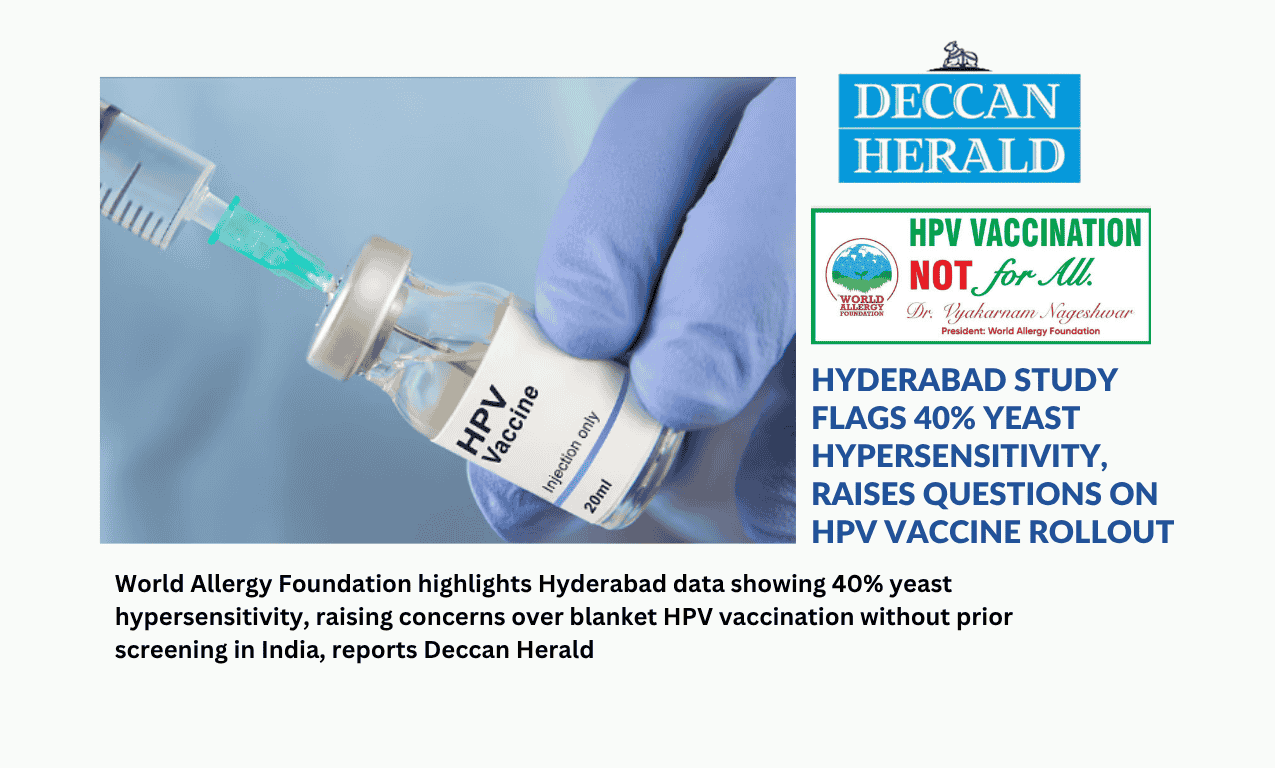
The following is an extract from a news article reported by SNV Sudhir and published by Deccan Herald, highlighting how yeast hypersensitivity can affect blanket HPV vaccination.
Hyderabad: Concerns are being raised over the blanket implementation of India’s nationwide HPV vaccination programme, with Hyderabad-based immunologists warning that administering the vaccine without screening for yeast hypersensitivity poses an unnecessary and avoidable risk, particularly in school-based or community-wide campaigns reaching millions of children and adolescents.
A retrospective analysis conducted in Hyderabad by World Allergy Foundation involving modified allergy skin prick tests on 300 randomly selected patients drawn from a larger database of 30,000 cases found that more than 40 percent exhibited hypersensitivity to yeast.
“This figure is notably high and aligns with broader patterns of elevated allergic sensitization observed in Indian cohorts, influenced by genetic, dietary, environmental, and regional factors. These elevated hypersensitivity reactions are observed due to gut dysbiosis, cytokine hyperactivity, and mast cell enhanced activation, particularly noted to be increased in the post-COVID era.
Administering HPV vaccines on a blanket basis—without accounting for this hypersensitivity—poses an unnecessary and avoidable risk, especially in school-based or community-wide campaigns reaching millions. While the cancer-preventive benefits of HPV vaccination against cervical and other HPV-related cancers are well-established and valuable, public health policy must prioritize individual safety alongside population-level gains,” said World Allergy Foundation founder president, Dr. Vyakarnam Nageshwar, on Wednesday.
Prime Minister Narendra Modi launched the nationwide voluntary HPV vaccination campaign on February 28, 2026, targeting approximately 1.15 to 1.2 crore girls aged 14 across all states and union territories
Dr Nageshwar said HPV vaccines currently approved and in use, including those produced using recombinant technology, are manufactured with Saccharomyces cerevisiae commonly known as baker’s yeast as the expression system. Residual yeast proteins remain in the final vaccine product, as documented in official vaccine labels, product monographs, and international immunisation guidelines. “Authoritative sources explicitly state that HPV vaccination is contraindicated in individuals with a documented history of immediate or severe hypersensitivity to yeast or other vaccine components,” he added.
He also raised concerns claiming absence of locally conducted clinical trials before rolling out a mass vaccination drive of this scale. The HPV vaccine trials were conducted primarily in Western populations, whose allergic profiles and genetic backgrounds differ considerably from those of the Indian subcontinent. Proceeding with blanket vaccination without India-specific safety data, he added, compounds the risk further. In a letter to the prime minister, he urged to reconsider the current approach of unrestricted, blanket HPV vaccination rollout and to incorporate safeguards like mandatory pre-vaccination clinical screening including a detailed history for any known or suspected severe yeast hypersensitivity or prior allergic reactions to yeast-containing products or vaccines.